Tuesday, February 12, 2008

Flying Soloist

So after listening to almost exclusively Mahler for just about 15 days running, I decided it was time for something different.


In one of my constant attempts to stay on the cutting edge of what’s new in music I picked up a disc of a composer I knew absolutely nothing about. The only thing I knew about this CD while buying it is that Martin Grubinger, the solo percussionist, is a force to be reckoned with. With it’s sleek hyper-modern neon cover art, something told me that composer Rolf Wallin would give me something aurally modern to chew on. And boy was I right, for those out there who like their modernism fast, lean and logical then step right up for Mr. Wallin’s wild ride. All the fat has been trimmed off his compositions, but that’s not to say his compositions are dry, oh no, quite the contrary. Had this music been created prior to the 2001: A Space Odyssey Stanley Krubrick would’ve tossed out his Ligeti LPs and replaced them with Wallin’s futuristic soundscapes.


A level headed approach to Brahms first piano concerto, soloist Cedric Tiberghien has the technical know-how to grasp what Brahms is dishing out (he also has pretty big hands from my understanding), but doesn’t dig in the way one often thinks Viennese romance should be. Instead he plays Brahms in a very Chopinesque manner, more gentle than we typically associate with Brahms. Conductor Jiri Belohlavek smooths out some of the more bombastic elements of the score and creates a cool, refined symphonic backdrop. His conducting in the Haydn Variations come across the same way, excellently played, but slightly too proper for Brahms. This team may be better suited for Schumann rather than a hot head like Brahms.
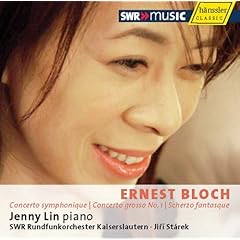


Now, I haven’t heard this one, but I encourage everyone to go out and buy it immediately. Ernst Bloch’s Concerto Grosso No. 1 has suffered from never receiving a recording that lives up to my standards. The best recording I’ve heard was tape recorded in someone’s lap at some college performance in Utah (I don’t even remember which college). I have sadly never found a recording that matches it’s intensity or spontaneity. “Why haven’t you bought this one” some people may be asking, well Hansslser is expensive and I’m not made out of gold. Normally I don’t recommend something so highly without hearing it first, but Jenny Lin is a fierce pianist with true instincts for music, I’d recommend any of her discs.


Here’s one to help start a discussion at the brandy parlor, Daniel Hope, who I believe is more well equipped to tackle modern masterpieces pieces than past warhorses, brings us the world premiere recordings of two of Mendelssohn’s most famous pieces, his Violin Concerto in E minor op. 64 and his Octet in E flat major op. 20 in their original unrevised form. Now I’m inclined to just outright say ‘the revised versions are better’ because I truly think that they are. But someone could easily persuade me away from that mindset by arguing that it’s just Daniel Hope’s playing, he’s just not as convincing as other players have been. So the jury is still out on this one, it’ll take a little digesting, perhaps another recording or two of the violin concerto and octet are in order before I make a final decision.


Can’t get enough Golijov? Well if you don’t mind him broken down into 2 minute increments then the score for Francis Ford Coppola's newest movie Youth Without Youth will have to be your next fix. Golijov speaks very highly about the making of the score, particularly working with Coppola, describing him as “…a great hero of mine…” and going on to say “I felt it was possible to fulfill every dream in life!” The score isn’t terribly engaging, but it’s good noncommittal music, music to listen to while doing something else.

Sunday, February 10, 2008

"The pity of war"

The music of the Twentieth Century echoed through Seattle's concert halls this weekend.  Michael Stern and the Seattle Symphony started the weekend with performances of Edgard Varese's rarely heard Integrales, Victor Herbert's equally rare Cello Concerto No.2 and the romantic longing of Rachmaninov's Symphony No.3.  However, the real treat of the weekend was Benjamin Britten's War Requiem.  George Shangrow and his talented, home-grown Orchestra Seattle and Seattle Chamber Singers played the Requiem.  By most accounts the piece has not been heard in the Puget Sound for almost thirty years.

Two themes ran through both performances.  On the one hand, Varese and Britten were deeply impacted by the  carnage of war.  Varese was conscripted into the army before he fell ill and made his way to the United States.  Similarly, Benjamin Britten was a staunch conscientious objector who crafted his Requiem for the dedication of the rebuilt Coventry Cathedral.  Britten also dedicated the piece to four friends who died during World War II.  The pessimism and renewal that follows a period of war are found in both pieces. 

Conversely, while Britten and Varese were taking music in new directions.  Varese exploding harmony and line in favor of "sound masses," rhythm and timbre and Britten later explored traditional forms in inventive ways, Sergei Rachmaninov and Victor Herbert seemingly clung to the old-fashioned, idioms of the past.   

Roughly 60 years separates the earliest work, Herbert's Cello Concerto No.2 (the earliest work) and the War Requiem (the latest).  The separation in time is not obvious.  Rachmaninov's symphony sounds as if it were composed contemporaneously with Herbert's concerto.  In fact, forty years separate the works.  Similarly, Varese's musicial idiom is so jarring that I suspect most listeners would not place the composition at the start of the last century.  Britten's War Requiem is just as elusive.    

Herbert's concerto seems obsolete in comparison to the work of his contemporaries (Debussy, Mahler, and Sibelius).  Nonetheless, as evidenced by his almost constant swaying and humming (?), guest cellist Lynn Harrell enjoyed the piece and so did the audience.  Harrell luxuriated in the work's artifice and the audience eagerly joined him on the ride.  Rachmaninov's Symphony No.3, composed less than a decade after Varese's uncomfortable Integrales, clings to the romantic sentiment that was being jettisoned by composers in Europe and America.  

Michael Stern is building a formidable career with the Kansas City Symphony by conducting pieces usually overlooked by larger, more well known orchestras.  This year alone, Stern is conducting excerpts from Berg's Wozzeck, Stephen Dankner's The Apocalypse of St. John, Lou Harrison's Concerto for Pipa and String Orchestra and Tchaikovsky's Symphony No.1, Winter Dreams.  His recent release on Naxos of Gordon Shi-Wen Chin's Double Concerto has been favorably reviewed by music critiques. 

The collision of red state Missouri and Kansas is an unusual place for new and forgotten classical music to find an audience.  It's a development that should give Seattle pause.    

Britten's War Requiem ties the past and present together.  His dissonance is counterbalanced with haunting moods and abundant atmosphere.  Britten's affinity for vocal composition is credited with restoring English operatic and choral tradition.  The War Requiem synthesizes all of these traits into a profound piece of music.

Britten juxtaposed the traditional mass for the dead alongside the anti-war poetry of Wilfred Owen.  Discord and placidity coexist side by side.  Notably, the sheer volume of the forces used and their placement (the boys chorus and chamber organ are off stage) are designed to create a three dimensional musical experience not unlike Stockhausen's Gruppen.

At a time when our own country is fighting two wars, Britten's music is as relevant now as it was in 1962 when the world was rebuilding from the catastrophe of the war to end all wars.  

Shangrow has a knack for tackling difficult works.  In December, he drew out a fine performance of Monteverdi's forward looking 1610 Vespers.  Later this year, he takes on Mahler's Symphony No.4.  Shangrow's Britten was no different.  

For almost ninety minutes, Shangrow had the piece unfold naturally.  The Northwest Boy's Choir was angelic.  I sat in the balcony where I was close to the crisp singing of the choir.  This may have been a mistake, since I did not get to experience how the choir sounds as it was intended.  Shangrow's tempos were patient.  He let the music unfold naturally, allowing the secular and sacred to become one.  The performance was satisfying from start to finish, culminating in a mesmerizing Libra me.     

The orchestra generated an unexpectedly full and somber sound.  I shouldn't be surprised, Shangrow has nurtured his orchestra building it into one of the better community orchestras in Seattle.  At times the brass had balance problems, drowning out the chorus, soloists and the orchestra.  The effect was powerful albeit distorted.  

Even though this weekend's performances were dominated by music of the Twentieth Century, Seattle depends (heavily) on the talent of visiting conductors and orchestra's like Orchestra Seattle to expose audiences to fare different from Brahms and Beethoven.  Without George Shangrow's steady vision of musical possibility, works like the War Requiem would never be heard.   

When Michael Stern took the microphone to introduce Integrales he gushed over Seattle's openness to modern music.  Peering out in the Benaroya Hall audience he had to see that there were plenty of empty seats.  If he had eyes in the back of his head he would have seen what I saw, restless thumbing of program notes during the Varese.  With a little bit of forethought and audience conditioning modern music can work in Seattle. 

Modern music need not be relegated to fifteen minutes at the start of program.  Shangrow's Britten proved this. 

Saturday, February 09, 2008

Upcoming

Seattle Symphony: Guest Conductor Michael Stern is in town this weekend to conduct SSO in Rachmaninoff Symphony No.3 and Victor Herbert's addictive Cello Concerto No.2.  Since taking over at the helm of the Kansas City Symphony, Stern has helped revitalize the city's arts scene.

Orchestra Seattle: Tomorrow, George Shangrow and his home-grown orchestra perform Benjamin Britten's War Requiem.  Britten's requiem is a gigantic work, setting poetry alongside the traditional Catholic mass, to create a piece that is one of the Twentieth Century's greatest musical achievements. 

Monday, February 04, 2008

In the shadow of a giant

The pre-concert lecture for the recent Seattle Symphony concert was titled "In the shadow of a giant."  The title, an obvious reference to Brahms' First Symphony.  Brahms labored for twenty years on his first symphony.  His creativity gripped by the belief that he could never surpass, let alone equal, the achievement in Beethoven's Ninth Symphony. 

However, the title could have been extended further to include the two other composers on the program.  Claude Debussy labored to break free from Wagner, Liszt and the rest of the music mainstream.  In a larger way, Debussy resided firmly in the long cast of the Twentieth Century and the avant garde music scene that was erupting around him in Paris.  Arnold Schoenberg's place in the continuum of music is more obvious.  A pupil of Zemlinsky, Schoenberg emerged from the post-Romantic world of Mahler seeking to extend and differentiate his own music from an extensive German musical tradition. 

While this past weekend's program wasn't exactly revolutionary, it was different enough to cause me to wonder what things might be like at Benaroya Hall if Schwarz ever left.  Debussy's practically unknown Symphonic Fragments from The Martyrdom of Saint Sebastian and Schoenberg's better known, Transfigured Night filled out the first half of the concert.  Ingo Metzmacher's approach to both was expansive and deliberate.   

In Transfigured Night, Metzmacher drew out ravishing solo playing from Susan Gulkis Assadi and quarter time concertmaster Frank Almond.  I wonder what incoming Milwaukee music director Edo de Waart thinks about Almond's part time gig and Schwarz's experiment? 

But, Almond and Assadi weren't the only ones deserving of credit.  Metzmacher pulled out of the Seattle Symphony strings an exceedingly fine performance that could have only come from a conductor with a keen understanding of Schoenberg's music.     

Metzmacher's Brahms was a aurally delicious way to end the concert.  Brahms struggled for two decades to finish his First Symphony and the obvious tension in the piece from struggle to triumph had critics to comparing the work to Beethoven's Ninth. 

Sunday's performance demonstrated the power of a controlled performance.  Metzmacher's command of the physics of the piece and orchestra created a tightly coiled sensation for the entirety of the work.  Most people probably prefer their Brahms on the wild, unrestrained side.  Perhaps, even a little opulent.  I should know, that's usually how I like my Brahms.  The only problem with highly emotional, overflowing, and unrestrained Brahms is that it leaves you worn out by the end.

Metzmacher's approach had my ears begging for more when the final notes were played.  Nearly the entire time, I was hoping for a Bacchanal to erupt.  However, Metzmacher's restraint peaked my anticipation and had me more engaged in the composer's symphony than I had been in a long time.          

Saturday, February 02, 2008

Diversion

Even though this is a blog about music, I can't resist.  My trade is politics and this, by any measure, is an amazing crowd for Senator Barack Obama.

Obama's Minnesota crowd

Senator Obama's rally today in Minnesota.

Friday, February 01, 2008

"Love and tragedy" no more

Some months back, this weekend's Seattle Symphony concert was dubbed "Love and Tragedy."  Back in September the program featured two Brahms works - the Tragic Overture and the Symphony No.1.  But, Schoenberg's Pelleas und Melisande was also on the program. 

However, the program has been considerably revised.  First, the Tragic Overture is out.  Perhaps there was too much Brahms.  Taking the place of the overture is Symphonic Fragments from Le Martyre de Saint Sebastien.  Debussy's  Le Martyre de Saint Sebastien is an odd work of incidental music which includes opera, cantata and orchestral music.  Debussy's amalgam was both his last attempt at composing for the stage and a flop.  Also jettisoned from the program is Schoenberg's Pelleas und Melisande.  In its place: Verklarte Nacht.  The piece is one of Schoenberg's earliest and is probably his most popular. 

Verklarte Nacht is a musical setting of Richard Dehmel's poem.  The poem's narrative is pretty simple.  A couple is strolling through a forest.  The woman confides in her lover that she is pregnant with the child of another man.  Rather than rejecting her, the woman's lover graciously embraces the circumstances, promising to make the child his own.

The "love and tragedy" are still there: martyrdom, the love of a woman and a child and the "tragedy" of Brahms difficulty composing his symphony.       

Wednesday, January 30, 2008

Release Date: February 12th

Harmonia Mundi and its affiliate labels have a promising set of new releases and re-issue slated for the 12th of February. Some of them include, but are not limited to...


Having tackled Handel's Op. 3 with much critical acclaim, worthy sales and a gramophone award, the Academy of Ancient Music and Richard Eggar set their sights on
Handel's Op.4 Organ Concertos. This is a priority release for Harmonia Mundi so expect lots of press, promotion and other hoopla in the coming months. For you audiophiles out there this is also an SACD Hybrid.


Harmonia Mundi's budget priced re-issue series Musique d'Aboard has six previously deleted titles reemerging, most of which focus strongly on early music including discs by Englishman John Blow, the young Rameau contemporary Jean Joseph Mondonville, early 20th century Spaniard Joaquín Turina, rococo composer Luigi Boccherini and 2 separate releases of early chant, one entitled Carmina Burana the other focusing on Syrian chant called Chant Traditionnel Maronite


And the hits just keep on coming. Sir Colin Davis and the LSO bring us a live recording of what may be the biggest tear jerker in classical music history, Mozart's Requiem (sorry, no link at the moment). Few would disagree that Davis is one of the premier Mozart interpreters around, having recorded more Mozart in his career than any other composer. If he puts out anything less than an absolutely exceptional performance my jaw will hit the floor.


Nothing gets my pulse racing like an eclectic pairing of pieces (I'm not sure why, they usually end up being awkward and strange) so needless to say, this new disc from Onyx has me salivating. The fantastic Christine Schäfer has chosen to pair up songs by the proper Brit, Mr. Henry Purcell, with American eccentric George Crumb on a disc called Apparition. Not only is she performing them together, but she's blending the twos compositions into one mass in order to help find parallels between the two. I can barely contain myself.


And finally, we have one for fanatics only. Testament is finally releasing the 1955, premiere stereo recording (according to Testament) of Der Ring des Nibelungen. Now, the four separate operas have been available previously, but this is the first time it's been all in one box. Testament is the very definition of a full priced label, so it's a commitment.